Magic Bullet: the little blender that changed the American kitchen
Most kitchen gadgets get two weeks on the counter before they migrate to the cabinet above the fridge. The Magic Bullet® has held its spot for over twenty years, and the reason isn't complicated: a smoothie takes ten seconds, rinsing the cup takes another ten, and the base is smaller than a coffee mug tree. More than 120,000 buyers have left a rating on the official listing, and the average has hovered around 4.4 stars for years.
What exactly is the Magic Bullet?
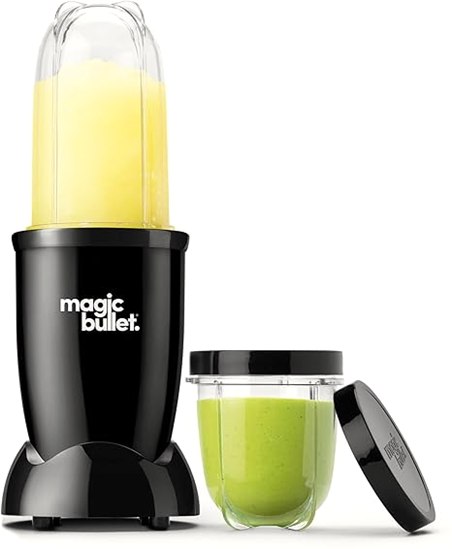
Technically, it's a 250-watt personal blending system with a patented cross-blade. In practice it works nothing like a traditional blender. There's no pitcher: you fill one of the individual cups, twist the blade on like a jar lid, flip the whole thing onto the base and press. No buttons, no speed chart. Pressure runs the motor; letting go stops it.
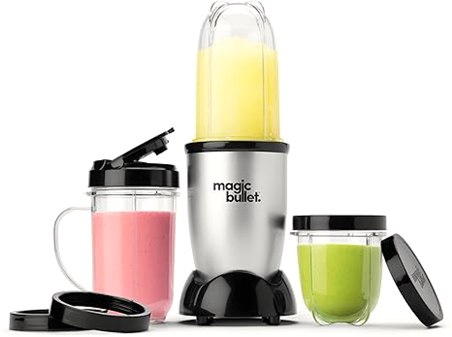
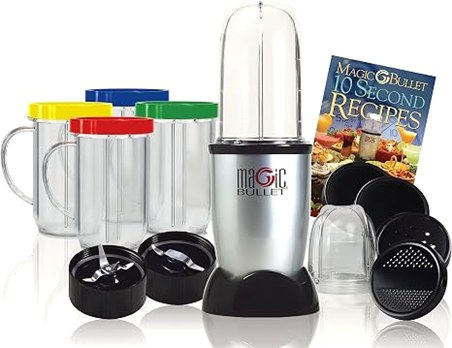
The signature 11-piece set includes the power base, the cross-blade, a tall cup, a party mug, two lip rings, resealable and to-go lids, and a recipe guide. Every container doubles as a serving cup: you blend your smoothie, protein shake or salsa directly in the vessel you'll drink or serve from. Fewer dishes, faster mornings.
Chops, mixes, blends, whips and grinds
Despite its size, the Magic Bullet is not a one-trick machine. The high-torque base combined with the cross-blade handles a surprising range of kitchen jobs:
- Smoothies and shakes. Frozen strawberries, a banana, yogurt and juice become a perfectly smooth drink in about ten seconds.
- Sauces and dips. Salsa, hummus, guacamole, pesto and salad dressings come out with restaurant texture — chunky or silky, you control it with pulse taps.
- Chopping. Onions, garlic, herbs and nuts are chopped evenly without tears or a cutting board.
- Batters and eggs. Pancake batter, omelet mixes and whipped desserts blend lump-free in seconds.
- Grinding. Coffee beans, flax seed, oats for oat flour, parmesan for pasta night — the blade powers through dry ingredients too.
Designed around real life, not around a spec sheet
Plenty of blenders on the market advertise bigger motors and taller pitchers. The Magic Bullet's engineers made a different bet: the best blender is the one you actually use every day. That philosophy shows up in dozens of small decisions. The footprint is tiny, so it lives on the counter instead of in a cabinet. The cups are made of durable, BPA-free plastic, so they go from blender to gym bag to top rack of the dishwasher. The blade twists on and off in a quarter turn, so cleanup is a ten-second rinse. And because the motor engages only when a cup is locked and pressed down, operation stays safe and intuitive for every member of the family.
None of this shows up on a spec sheet, but it's exactly why the machine gets used in March and not just the first week of January. A blender that takes less time than a toaster stops being an appliance you plan around and becomes part of the routine — which, for most people, is the difference between owning a blender and drinking smoothies.
A model for every household
The lineup has grown well beyond the original silver bullet, and choosing the right one comes down to how you cook:
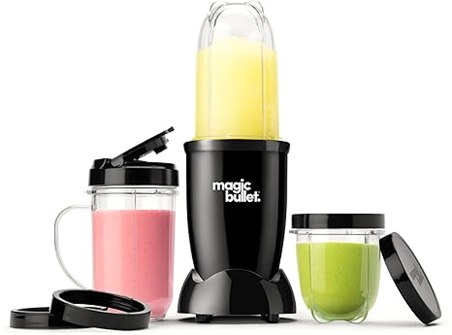
- Magic Bullet 11-Piece Set (250W) — the classic and the long-running best seller at $39.99. Ideal for singles, couples, students and anyone who mainly makes smoothies, shakes, dips and dressings. Available in silver and black to match your kitchen.
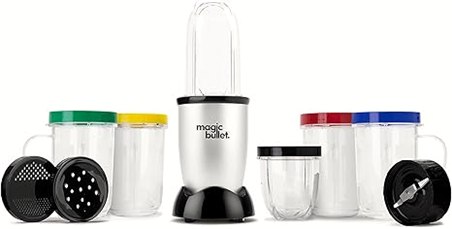
- 17-Piece Express Mixing Sets — the same fast blending platform with more cups, more lids and more accessories. Perfect for families where everyone blends their own breakfast, or for meal-preppers who portion the week ahead.
- 7-Piece Blender + Food Processor Set — adds a compact food-processing attachment for slicing and shredding, turning the Bullet into a two-in-one prep station for under $45.
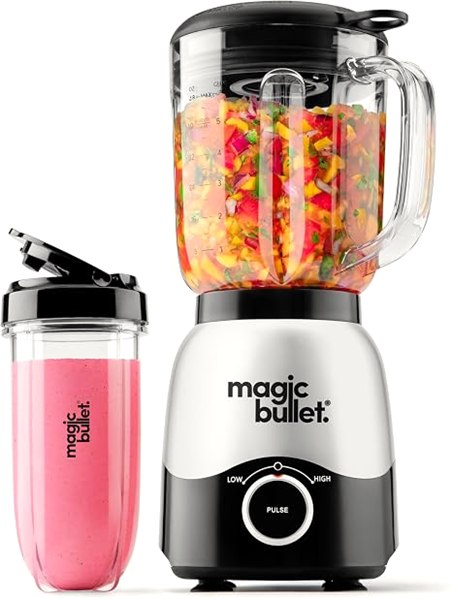
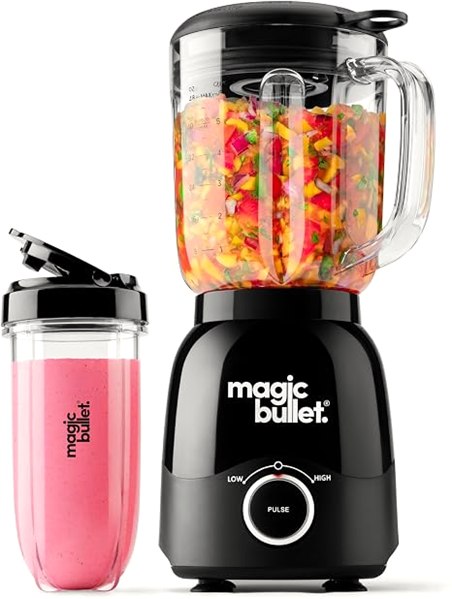
- Combo Blender 600W with 48oz Pitcher — when you need family-size batches: frozen margaritas for guests, soup for four, big-batch salsa. The 600-watt motor and vented pitcher even handle hot blends, while the included 16oz cup keeps the personal to-go workflow.
What owners and reviewers actually say
The press verdicts line up with the owner reviews to an unusual degree. Homes & Gardens, after lab-testing the 11-piece set, summed it up as "a truly brilliant basic" — inexpensive, effective, honest about its limits. Their reviewer's one caveat matches ours: for daily ice-crushing you want the bigger 600W Combo, not the personal cups.
Dig through the verified-purchase reviews and the same notes repeat. A buyer from December 2024 called it a solid little blender for the price that handles soft fruit and leafy greens without drama. Another, six months into daily use, wrote that her whole breakfast routine now fits in the forty seconds her coffee takes to brew — and that the flip-top to-go lid was the detail that sold her. The longevity stories are the part we like best: reviews from people retiring a Bullet after eight or ten years of mornings, almost always to buy another one.
The bottom line
If you run a nightly frozen-drink operation for six, buy a high-performance pitcher machine and give it the counter space it demands. For everything else — weekday smoothies that actually happen, salsa made fresh instead of bought, a machine your ten-year-old can run unsupervised — forty dollars has rarely bought more kitchen. Twenty years of sales say the same thing.
Two decades of a kitchen icon
The Magic Bullet first arrived in October 2003, produced by Homeland Housewares (part of Alchemy Worldwide) and developed by a team that included Lenny Sands, who holds the original patent. Even the name has a design story behind it: it comes from the graceful, bullet-like ogive curve of the blending cups. From day one the concept was radical in its simplicity — attach a blade to a cup, set it upside-down on the base, press, and blend.
What turned it into a household name was one of the most recognizable infomercials ever aired: a relaxed 30-minute "kitchen party" hosted by a pair of cheerful presenters walking a cast of houseguests through breakfast, cocktails and dips — every task promised in "10 seconds or less." That tagline became shorthand for the whole product, and it stuck because the machine genuinely lived up to it.
The audience responded on a scale few kitchen products ever reach. In its first roughly 17 months on the market the Magic Bullet brought in about $250 million, and today it's sold in more than 50 countries. Its success spawned an entire family of spin-offs over the years — the To Go, the Mini, the Bullet Express, the Baby Bullet for homemade baby food, the Dessert Bullet, and the larger NutriBullet line — but the compact original remains the one that started it all, and the one that still earns its place on the counter every morning.